What Aesthetic Treatments Help After Significant Weight Loss at a Tacoma Medical Spa?
First, let’s take a moment to acknowledge something important: you did it.
You committed to your health. You showed up for your appointments. You navigated the side effects, adjusted your habits, and watched the scale move in a direction it hadn’t gone in years — maybe decades. Whether you lost 30 pounds or 100+ pounds with semaglutide, tirzepatide, or another medically supervised program, that achievement is profound.
But if you’re reading this, there’s a good chance your celebration has been tempered by something you didn’t fully anticipate: the body staring back at you in the mirror doesn’t quite match how you feel inside.
Loose skin around your abdomen. Stubborn pockets of fat that won’t budge despite your smaller frame. A jawline that feels less defined than it should. Arms, thighs, or a midsection that sag where they once stretched.
You’re not alone. And there’s nothing wrong with wanting your outside to reflect the incredible transformation happening within.
At Millenia Medical Center, our Tacoma medical spa team works with GLP-1 weight loss patients every single day who are navigating this exact moment. This guide is for you — to help you understand why these changes happen, what can be done about them, and why the next chapter of your journey might be the most rewarding one yet.
Why Does Loose Skin Happen After GLP-1 Weight Loss?
The Science of Skin Laxity After Rapid Fat Reduction
To understand loose skin after weight loss, you need to understand what happened beneath the surface during the years your body carried excess weight.
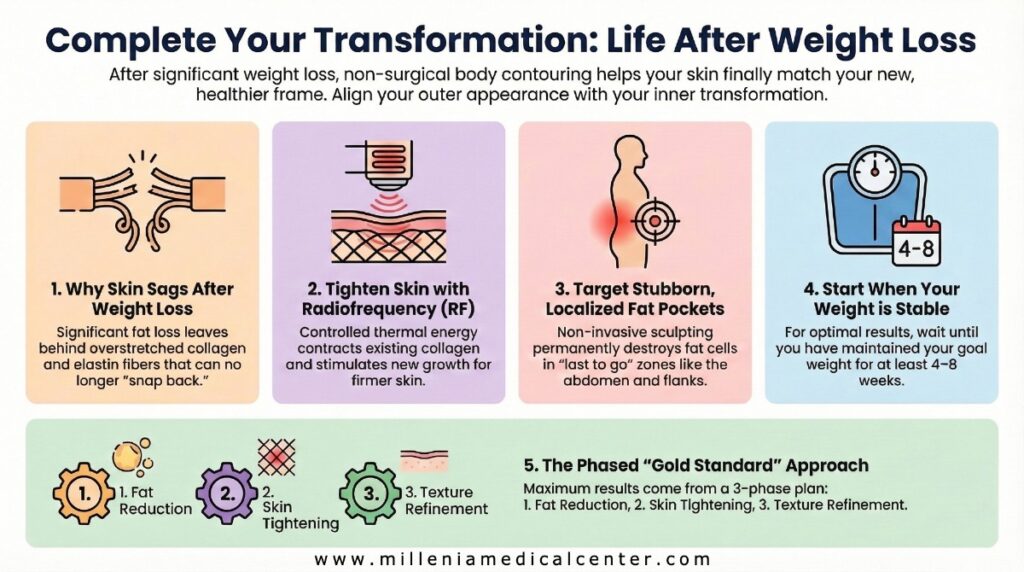
Your skin is a remarkably adaptive organ. When you gain weight — particularly over an extended period — your skin stretches to accommodate the increased volume. Over time, this sustained stretching causes structural damage to two critical proteins:
- Collagen — the protein responsible for your skin’s firmness and structure
- Elastin — the protein that gives skin its ability to “snap back” after being stretched
Think of it like a rubber band that’s been stretched wide and held in that position for years. When you finally release it, it doesn’t return to its original shape. The elastic fibers have been permanently altered.
When GLP-1 medications like semaglutide and tirzepatide produce significant, often rapid fat loss, the underlying volume that was filling out your skin diminishes — sometimes faster than your skin’s biology can adapt. The result is skin laxity: loose, sagging, or crepey skin that remains even after the fat beneath it is gone.
Factors That Influence the Severity of Loose Skin
Not every weight loss patient experiences the same degree of skin laxity. Several factors determine how your skin responds:
- Total amount of weight lost — Greater volume loss typically means more excess skin
- Speed of weight loss — GLP-1 medications can produce faster results than traditional methods, giving skin less time to retract
- Age — Collagen and elastin production naturally decline with age, reducing skin’s remodeling capacity
- Duration of obesity — The longer skin has been stretched, the more structural damage occurs
- Genetics — Some individuals naturally produce more collagen and have greater skin elasticity
- Sun exposure history — UV damage accelerates collagen breakdown
- Smoking history — Tobacco use significantly impairs skin’s ability to heal and regenerate
Understanding these factors isn’t meant to discourage you — it’s meant to empower you with knowledge. Because once you understand why loose skin happens, the solutions become much clearer.
The Emotional Reality: Why This Matters More Than Aesthetics
You Didn’t Lose the Weight to Feel Self-Conscious
Let’s be honest about something the medical community doesn’t discuss enough: loose skin after weight loss is not just a cosmetic concern. It’s an emotional one.
Patients tell us:
“I finally hit my goal weight, but I can’t wear the clothes I dreamed about.”
“I feel like I traded one insecurity for another.”
“I’m proud of my weight loss, but I don’t feel comfortable in my own skin — literally.”
These feelings are valid. They are common. And they are treatable.
Seeking body contouring or skin tightening after weight loss isn’t vanity. It’s the natural, logical next step in a journey you’ve already courageously begun. At Millenia Medical Center, we see it as the final chapter of your transformation — and we’re honored to help you write it.
Body Contouring and Skin Tightening Treatments in Tacoma: Your Options
Non-Surgical Solutions for Post-Weight-Loss Body Sculpting
One of the most empowering aspects of modern aesthetic medicine is that you don’t necessarily need surgery to see dramatic improvement. Advances in non-invasive and minimally invasive technology have created a suite of options that can tighten skin, eliminate residual fat, and sculpt your new figure — all without general anesthesia, large incisions, or extended downtime.
At our Tacoma body contouring clinic, we offer personalized treatment plans that may include one or more of the following approaches:
Radiofrequency (RF) Skin Tightening
How it works: Radiofrequency technology delivers controlled thermal energy deep into the dermal layers of your skin. This heat serves a dual purpose:
- Immediate contraction of existing collagen fibers, producing a visible tightening effect
- Stimulation of new collagen and elastin production (neocollagenesis), which continues to improve skin firmness for months after treatment
Best for: Mild to moderate skin laxity on the abdomen, arms, thighs, neck, and face. Particularly effective for patients who have good skin quality but need a “tightening boost” after weight loss.
What patients love:
- Non-invasive with zero downtime
- Gradual, natural-looking improvement
- Comfortable treatment experience
- Results that build progressively over 3–6 months
Body Sculpting & Fat Reduction Treatments
The reality most patients don’t expect: Even after significant GLP-1 weight loss, many patients discover stubborn, localized fat deposits that don’t respond to continued medication or lifestyle changes. These are often genetically determined fat distribution patterns — the body’s “last to go” zones.
Common problem areas include:
- Lower abdomen and “pooch”
- Love handles and flanks
- Inner and outer thighs
- Upper arms
- Submental area (double chin)
Advanced body sculpting technologies can selectively target and reduce these fat deposits without surgery, allowing your new, leaner frame to emerge more fully.
What patients love:
- Targeted treatment of specific problem areas
- No incisions, no anesthesia
- Minimal to no downtime
- Permanent destruction of treated fat cells
Collagen-Stimulating Treatments
How they work: A category of advanced aesthetic treatments works by creating controlled micro-injuries or thermal zones within the skin, triggering the body’s natural wound-healing response. This response produces new, healthy collagen — the very protein your skin needs to regain firmness.
These treatments may include:
- Microneedling with growth factors — Fine needles create thousands of micro-channels in the skin, stimulating collagen remodeling from within. When combined with growth factor serums or PRP (platelet-rich plasma), results are amplified significantly.
- Laser skin resurfacing — Fractional laser technology addresses both skin laxity and texture concerns, including stretch marks that often accompany weight fluctuations.
Best for: Patients seeking improvement in both skin tightness and overall skin quality, texture, and tone.
Combination Therapy: The Gold Standard Approach
Here’s what we’ve learned from treating hundreds of post-weight-loss patients at our medical spa in Tacoma: the most transformative results rarely come from a single treatment.
The gold standard approach combines multiple modalities in a strategic, phased treatment plan:
| Phase | Focus | Example Treatments |
| Phase 1 | Reduce residual stubborn fat | Body sculpting & fat reduction |
| Phase 2 | Tighten and firm loose skin | Radiofrequency skin tightening |
| Phase 3 | Refine skin quality & texture | Microneedling, laser treatments |
| Ongoing | Maintain and optimize results | Periodic maintenance sessions |
This layered approach mirrors how your body naturally heals and remodels — and it’s far more effective than any single treatment performed in isolation.
Why a Medical Spa in Tacoma Is the Right Setting for Post-Weight-Loss Body Contouring
Clinical Expertise Meets a Wellness-Focused Experience
You’ve already navigated the clinical side of weight loss — the prescriptions, the lab work, the dosage adjustments. The next phase of your journey should feel different. It should feel like a reward.
A medical spa setting offers something that neither a traditional doctor’s office nor a day spa can match:
- Medical-grade treatments performed or supervised by licensed healthcare professionals
- Advanced technology that isn’t available in standard spa environments
- A warm, relaxing atmosphere that prioritizes your comfort and dignity
- Comprehensive consultations that treat you as a whole person, not a procedure number
- Safety protocols and clinical standards that protect your health at every step
At Millenia Medical Center, our providers understand the specific needs of GLP-1 weight loss patients. We don’t offer generic body contouring — we design programs informed by your weight loss history, your skin’s current condition, your aesthetic goals, and the realistic timeline for achieving them.
The Advantage of Continuity of Care
If you completed your GLP-1 weight loss program at Millenia Medical Center, transitioning to aesthetic treatments is seamless. Your providers already know your medical history, your body’s response patterns, and your goals. There’s no redundant intake process, no re-explaining your journey — just a natural continuation of the care you’ve already trusted us with.
And if you completed your weight loss elsewhere? You’re equally welcome. We’ll take the time to understand your full history and build a fresh plan from the ground up.
Addressing Common Concerns: What We Hear From Post-GLP-1 Patients
“Is it too soon to start body contouring after weight loss?”
Timing matters. We generally recommend that patients reach a stable weight — meaning your weight has plateaued or you’ve been within 5–10 pounds of your goal for at least 4–8 weeks — before beginning body contouring treatments. This ensures we’re sculpting and tightening your final figure, not a body still in transition.
During your consultation, we’ll assess whether you’re at the ideal starting point or whether a brief waiting period would optimize your results.
“Will the loose skin tighten on its own over time?”
Partially, for some patients. Mild skin laxity in younger patients with good skin quality may improve modestly over 12–24 months as the skin gradually remodels. However, for most patients who’ve experienced significant weight loss (30+ pounds), the degree of skin retraction that occurs naturally is not sufficient to achieve their desired appearance.
The earlier you begin collagen-stimulating treatments, the more effectively you can support and accelerate your skin’s natural remodeling process.
“Are non-surgical treatments really effective enough, or do I need surgery?”
It depends on the severity of your skin laxity. Non-surgical treatments are remarkably effective for mild to moderate loose skin and are the preferred starting point for many patients. For severe skin excess — particularly large “aprons” of abdominal skin or significant laxity on the upper arms — surgical options like abdominoplasty or brachioplasty may ultimately provide the best outcome.
At Millenia Medical Center, we’ll give you an honest, realistic assessment. If non-surgical treatments can achieve your goals, we’ll design that plan. If we believe surgical intervention would serve you better, we’ll tell you that, too — and can refer you to trusted surgical colleagues in the Tacoma area. Our priority is your outcome, not upselling a procedure.
“How much does body contouring after weight loss cost?”
Treatment costs vary based on the areas treated, the technologies used, the number of sessions needed, and your individual treatment plan. During your consultation, we provide transparent, detailed pricing with no hidden fees. We also offer financing options to ensure your transformation remains accessible.
Your GLP-1 Success Story Isn’t Over — It’s Entering Its Best Chapter
Let’s reframe the narrative.
Loose skin after weight loss isn’t a failure. Stubborn fat pockets aren’t a sign that your medication didn’t work. The gap between where you are and where you want to be isn’t a setback — it’s an invitation.
An invitation to finish what you started. To align your outer appearance with the inner transformation you’ve already achieved. To look in the mirror and finally see the person you’ve been working so hard to become.
Body contouring and skin tightening after GLP-1 weight loss in Tacoma isn’t a separate journey — it’s the next natural step in the one you’re already on. And at Millenia Medical Center, we’re ready to walk that path with you.
Ready to Complete Your Transformation? Let’s Talk.
Schedule your complimentary body contouring consultation at Millenia Medical Center today.
During your one-on-one consultation, a member of our expert team will:
✅ Assess your skin laxity and body composition in person
✅ Discuss your aesthetic goals and desired timeline
✅ Recommend a personalized, phased treatment plan
✅ Provide transparent pricing and financing options
✅ Answer every question — no rush, no pressure
📍 Proudly serving Tacoma, Lakewood, University Place, Federal Way, Puyallup, and all of Pierce County.
📞 Call us today or visit milleniamedicalcenter.com to book your consultation.
You fought for this body. Now let us help you love every inch of it.
Disclaimer: This content is for informational purposes only and does not constitute medical advice. Individual results vary. Body contouring and skin tightening treatments carry risks and are not suitable for all patients. A consultation with a qualified medical provider is required to determine candidacy and develop an appropriate treatment plan. Some treatments described may require multiple sessions for optimal results. Before-and-after outcomes depend on individual factors including skin quality, age, treatment area, and adherence to post-treatment care guidelines.